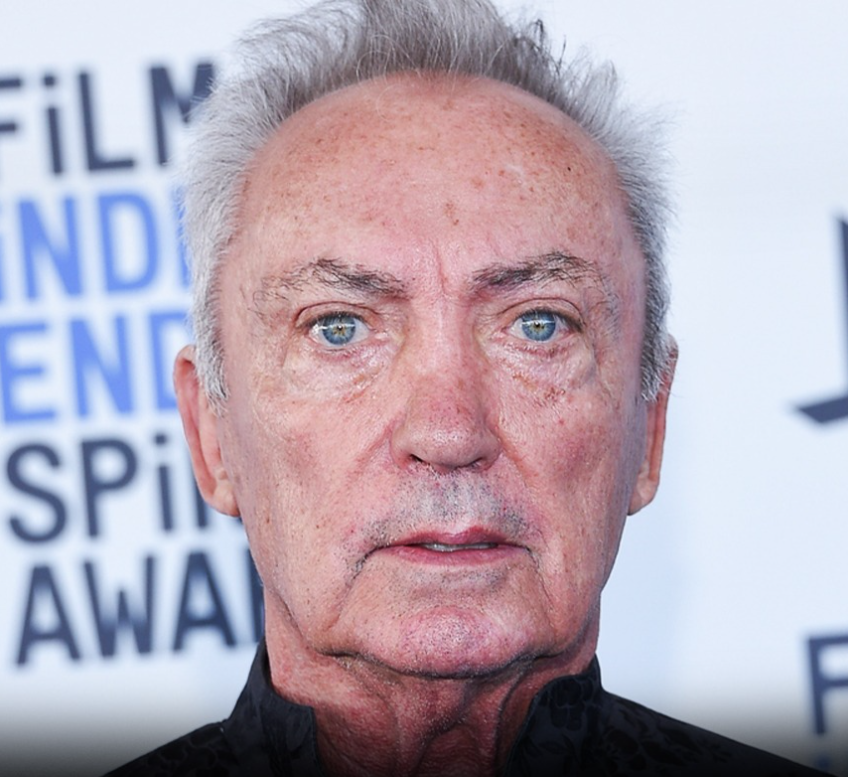
Udo Kier’s life began in chaos, and that chaos somehow shaped him into one of the most unforgettable actors ever to appear on screen. Born Udo Kierspe in Cologne in 1944, he entered the world at the worst possible moment—just hours before the hospital where he was born was bombed. Rescuers pulled his mother and newborn body from the rubble, a brutal introduction to a life marked by hardship, poverty, and fractured family ties.
His father had another family entirely—three children his mother never knew about when she became pregnant. By the time Udo learned the truth, he had already spent years without stability or comfort, living in a home without hot water until he was seventeen. In interviews, he described his childhood as “horrible,” not out of resentment but out of honesty. Those early struggles hardened him, sharpened him, and gave him the striking presence that later gripped audiences.
His first real escape from that bleak world came when he moved to London to study English. A chance encounter in a café—someone noticing his extraordinary looks—changed everything. He once joked, “I liked the attention, so I became an actor,” but the truth was simpler: people couldn’t look away from him.
Kier’s breakthrough came with the 1970 horror film Mark of the Devil, a notorious classic that established him as someone who could embody beauty, darkness, and danger all at once. Audiences remembered him. Directors remembered him. Cinema on both sides of the Atlantic quickly realized that Udo Kier wasn’t meant for safe parts—he was made for the roles that linger in the mind.
Then fate intervened again. On a flight, he was coincidentally seated next to director Paul Morrissey—Andy Warhol’s collaborator. That single plane ride led to Flesh for Frankenstein and Blood for Dracula, two cult landmarks that secured his place in film history. He became the face of charismatic evil: tyrants, vampires, madmen, monsters. If a script required someone unforgettable, unnerving, impossible to ignore, they called Udo Kier.
In another world, he might have become a glamorous 1970s heartthrob—he had the face, the intensity, the magnetism. But he chose stranger, darker paths. That choice made him legendary.
His career spanned more than 275 films, working with directors most actors could only dream of. Rainer Werner Fassbinder cast him repeatedly—Lili Marleen, Lola, The Third Generation. Lars von Trier built entire characters around him in Dogville, Breaking the Waves, Melancholia, Dancer in the Dark, and Nymphomaniac. Kier even became godfather to von Trier’s child.
Hollywood embraced him as well. He appeared in My Own Private Idaho, collaborated creatively with Madonna, and entertained audiences in everything from Ace Ventura: Pet Detective to Blade, Armageddon, End of Days, Dragged Across Concrete, and the vastly underrated Swan Song, where he played a retired hairdresser on one last flamboyant journey—a role that revealed the gentleness behind his sharp edges.
Gamers knew him too. His performance as Yuri in Command & Conquer: Red Alert 2 became iconic, his eerie yet hypnotic delivery making him a cult favorite in the gaming world.
What made him unforgettable wasn’t only his face or talent—it was his fearlessness. He once said, “It’s better to scare people than to be forgotten.” He lived that truth in every role.
Yet behind the madness was a man who was gentle, witty, openly gay, and fully at ease with himself. He moved to Palm Springs in 1991, into a converted mid-century library—because of course he did. He filled it with art, architecture, and life. He loved gardening, meeting fans, attending festivals. Everyone described him as warm, curious, gracious.
When asked about being openly gay in Hollywood, he simply replied, “Maybe it was obvious, but no one cared. All that mattered was that I did the role well.”
That was Udo Kier—unfiltered, unapologetic, and uninterested in hiding.
He summed up his career with dry humor:
“100 movies are bad, 50 you can watch with wine, and 50 are good.”
After fifty years in film, he could say it with a smirk—and mean it.
Udo Kier died in Palm Springs at 81, surrounded by the art he loved, adored by fans across generations, and still one of cinema’s most singular presences. His partner, Delbert McBride, confirmed his passing. No cause was given. Some people leave the world the same way they enter it—quietly, yet leaving a mark no one can forget.
From the ruins of a bombed hospital to the heights of cult superstardom, Udo Kier carved a path no one could replicate. He played villains, oddballs, and eerie figures lurking at the edge of the frame—but he did so with such style, intensity, and commitment that he elevated every part he touched.
Rest in peace, Udo Kier.
A fearless original, a once-in-a-generation performer, and a legend whose shadow will never fade.