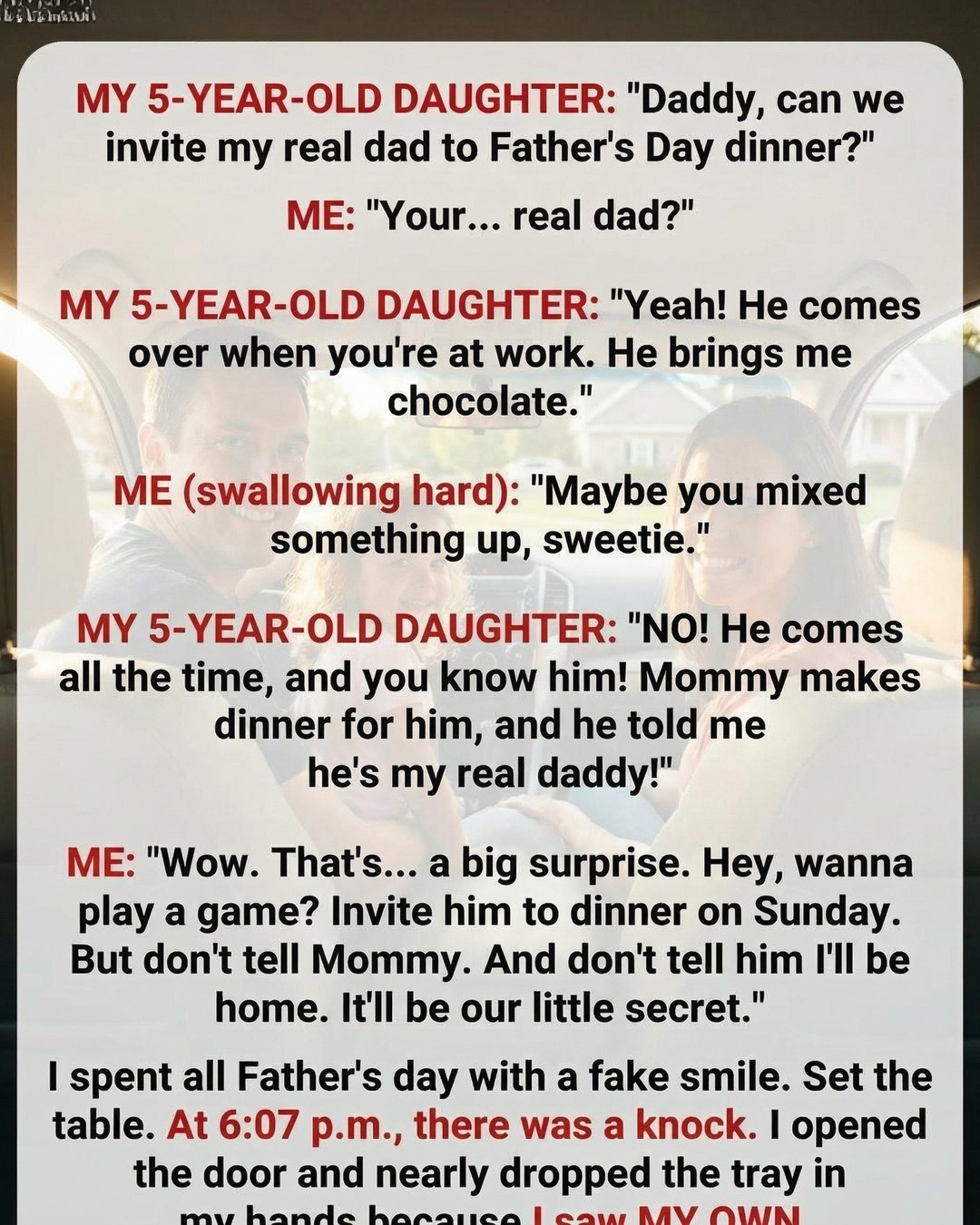
Father’s Day was supposed to be simple—warm, easy, predictable. I imagined pancakes on the table, glitter-covered cards taped to the fridge, and my daughter’s small arms wrapped around my neck before I’d even had my coffee. Instead, the day blindsided me. It reminded me that the truth has a way of surfacing at the most unexpected moments, sometimes through the smallest voices.
Lily, my five-year-old, has always drifted between reality and the worlds she creates in her mind. She treats puddles like magical doors and believes the moon follows us because it prefers our neighborhood. So when she spoke up from the back seat with a question that didn’t fit her usual imagination—one that felt too pointed, too real—I froze.
The innocence in her voice was what hurt the most. She wasn’t trying to confuse me or hint at something dramatic; she was simply sharing what she believed was normal. There was no suspicion, no hesitation—just a child speaking honestly about her day-to-day life.
I forced myself to stay calm. Panic wouldn’t help either of us. I kept my voice soft, steady, warm—guiding her into conversation without letting her sense that anything was wrong. She talked openly, unaware that each detail slowly rearranged the ground I stood on. While she described moments that happened when I was at work, a quiet unease settled in my chest—not fear, just the gnawing recognition that something in our home wasn’t what I thought it was.
Instead of interrogating her or making her feel responsible, I turned the conversation into a game. I told her we were planning a “Father’s Day surprise dinner” and had to gather clues—fun little details—to make it perfect. She lit up at the idea, excited to help. I smiled and played along, even as my mind churned with questions I wasn’t ready to voice.
That evening, with my wife out on a photography assignment, Lily and I cooked together. She insisted on setting the table herself, placing forks crookedly and pushing a vase of sunflowers—picked earlier from the garden—into the center. The vase leaned, threatening to topple with every bump, but she stepped back proudly and announced, “It’s perfect.” And somehow, in its small, uneven way, it was.
The knock came just as we were finishing. It wasn’t loud, but it cut straight through the quiet of the house. The person on the other side wasn’t unknown, but the look on their face made one thing clear—they hadn’t expected to be there either.
The conversation that followed didn’t explode. There were no slammed doors or raised voices. Instead, it unfolded in low tones, each sentence carrying the weight of years spent avoiding hard truths. Misunderstandings brushed aside for years resurfaced. Decisions once made in silence were finally voiced. Some of it hurt. Some of it brought clarity. All of it needed to be said.
By the time the door closed and the house fell quiet again, the sunflowers on the table had begun to droop. Lily, too little to grasp the meaning behind the adult conversation, hummed softly while coloring at the counter. I stood there, watching her small hand move across the page, feeling the sharp edge of reality press in. I didn’t know what the next few days would bring, but I knew my decisions had to center around her.
In the days that followed, my focus narrowed to one priority: keeping Lily’s world steady. I stuck to the routines she knew—morning cartoons, her favorite strawberry oatmeal, the nightly ritual of brushing her doll’s hair before bed. When she asked questions, I answered them gently, framing everything through the lens of love and stability. Kids don’t need every detail. They need reassurance, anchors, safety.
One night, after reading her favorite bedtime book, she scooted closer and placed her small hand on my chest.
“Daddy?” she whispered. “Are you still my daddy?”
The question cracked something open in me. It wasn’t dramatic or loaded from her perspective. It was pure, honest, simple. She wanted to know if the love she depended on was still solid.
I wrapped my arms around her and held her close.
“I’ve always been your daddy,” I told her, steady and sure. “And I always will be. Nothing changes that.”
She nodded against my shoulder, gripping her stuffed rabbit with her free hand. Her breathing softened, slow and even—the kind that comes only when a child feels safe again. In that moment, despite everything unsettled beneath the surface, the world felt just a little less heavy.
The days ahead will bring more conversations, more truths, more work. Nothing resolves overnight. But love—the real kind, the steady kind—isn’t shaken by revelations or mistakes. It anchors itself in the quiet moments, the whispered reassurance, the promise that family is built on more than biology or conflict. It’s built on presence, patience, and the commitment to show up even when the ground shifts.
Father’s Day didn’t go the way I planned. But maybe it went the way it needed to. It peeled back every layer hiding what needed to be faced and reminded me that the bond between a parent and a child isn’t fragile—it’s resilient, rooted in something deeper than circumstance.
As Lily fell asleep that night, curled beneath my arm, I realized the truth that mattered most: whatever our family becomes, the love we have is still here, still strong, still ours to protect.