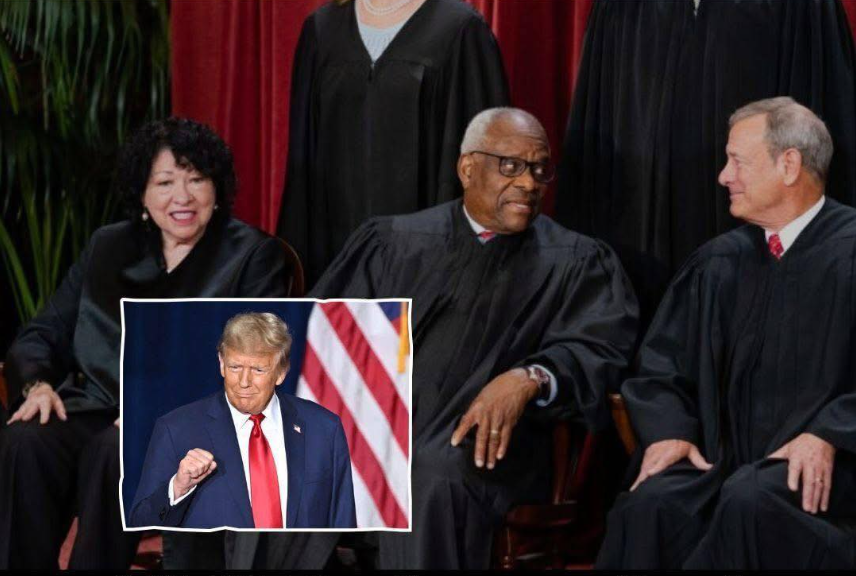
A legal earthquake has just struck Washington, sending reverberations throughout the nation’s political and humanitarian landscape. In a stunning and decisive 8–1 decision, the Supreme Court handed former President Donald Trump a sweeping victory on immigration policy—an outcome that drew support even from justices typically aligned with more liberal interpretations of the law. The ruling has immediate and profound consequences: overnight, roughly 300,000 Venezuelan migrants who had been living in the United States under Temporary Protected Status (TPS) were transformed from legally “protected” residents to individuals potentially subject to deportation. For these families, the legal decision is not a mere technicality; it threatens the stability of homes, careers, communities, and futures built over years of uncertainty and hope. One dissenting justice warned that the ramifications could be “devastating,” a remark that underscores the human stakes behind the high court’s formal language.
The Supreme Court’s ruling does more than vindicate the legal strategies employed by Trump’s team. It reshapes the broader boundary between presidential authority and humanitarian protection in ways that will influence policy for years to come. By overturning the lower court’s injunction, the justices effectively sided with the administration’s argument that TPS is fundamentally a matter of foreign policy discretion rather than a guarantee of safety for vulnerable populations. For the Venezuelan migrants who have relied on TPS to live, work, and raise children in the United States, this legal distinction translates into tangible consequences: a looming threat of removal, disrupted careers, broken family units, and the sudden erasure of years of hard-won stability.
Behind the austere legal language and the formal judicial opinion are real lives packed into crowded apartments, small family-owned businesses, and neighborhoods sustained by immigrant labor. Many of these migrants have children born in the United States, for whom the thought of separation from their parents is unimaginable. The decision also intersects with policy memos such as the one issued by Kristi Noem’s Department of Homeland Security, which framed continued protection under TPS as contrary to the “national interest.” Already, the U.S. has seen deportation numbers climb past half a million removals under similar policies, and the ruling signals that more families may soon face displacement. Supporters of the decision argue that it restores the executive branch’s authority over immigration enforcement and serves as a deterrent against unlawful entry. Critics, on the other hand, view it as a drastic measure that dismantles families and undermines the moral commitments implicit in America’s long-standing tradition of offering refuge to the vulnerable.
As buses and planes are readied to transport individuals who once believed they were legally secure, the ruling compels the country to confront a stark reality: what the government promises in law may not align with the lived experience of those it ostensibly protects. Policy experts note that the decision may trigger broader questions about the scope of presidential discretion, the rights of foreign nationals under temporary protective measures, and the humanitarian obligations of the United States in times of crisis abroad. Advocacy groups have begun mobilizing, offering legal aid, emergency support, and public awareness campaigns to assist affected families. Meanwhile, local communities grapple with the potential social and economic impact of losing residents who have contributed to schools, businesses, and civic life.
The decision also illuminates a tension that lies at the heart of U.S. immigration policy: balancing national sovereignty and enforcement priorities with the country’s humanitarian responsibilities. The Supreme Court ruling is not merely a matter of legal interpretation; it has immediate, life-altering implications for hundreds of thousands of people, their children, and their communities. Families once secure under TPS now face uncertainty that affects housing, employment, and education, while the nation as a whole is confronted with the ethical and practical consequences of its immigration framework. As the country processes the ruling, policymakers, courts, and advocacy groups alike will be forced to navigate the difficult terrain between legal authority and human impact—a challenge that will define U.S. immigration policy for the foreseeable future.