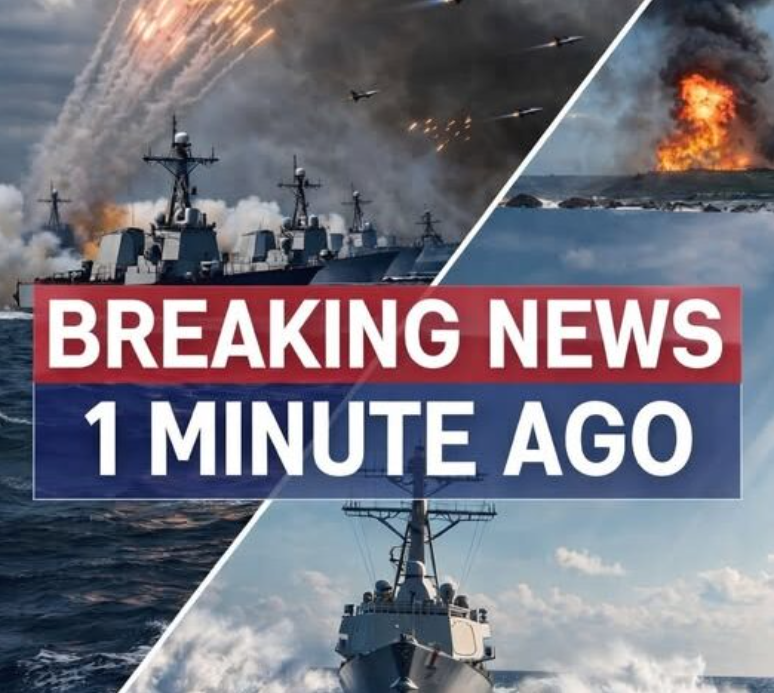
The Red Sea has long been recognized as one of the most strategically vital maritime corridors in the world, a narrow, sometimes deceptively calm channel that carries a significant portion of global trade and energy supplies. Ships laden with oil, gas, containerized goods, and raw materials traverse its waters daily, linking Europe, Africa, and Asia through a waterway that has defined commerce for centuries. Yet, in recent months, the Red Sea has transformed from a mere commercial artery into a high-stakes theater of modern naval warfare. A dramatic and unprecedented confrontation between United States naval forces and Houthi militants has sent shockwaves rippling through the international community, signaling a dangerous and escalating phase in Middle Eastern security that analysts are likening to a wake-up call for naval strategy in the 21st century. Central to this escalation was a staggering tactical feat: the simultaneous launch of 36 missiles against a single U.S. destroyer within an astonishingly brief window of just 22 minutes. The sheer audacity of the attack speaks not only to the evolution of asymmetric maritime tactics but also to the immense pressure these contested waters place on global powers and their military planners.
At the core of this engagement lies a concept military strategists refer to as a “saturation attack.” This method of assault is not merely about brute force; it is a carefully calculated attempt to overwhelm the defensive capacities of the target. Modern warships, no matter how technologically advanced, have a finite number of threats they can track on radar and intercept simultaneously. A well-executed saturation attack exploits this limitation by flooding the target with projectiles faster than the ship can effectively respond. In this particular incident, the Houthi forces sought to create precisely that window of vulnerability. By launching 36 missiles in rapid succession, they pushed the U.S. destroyer’s defensive systems to the brink, testing the limits of the Aegis Combat System, radar arrays, interceptor missiles, and the crew’s operational endurance. Each missile represented not just a physical threat, but also a psychological one, forcing the sailors to operate under extreme pressure and make split-second decisions that could determine life or death.
The technological sophistication behind the destroyer’s defensive capabilities cannot be understated. Its layered defense system integrates radar detection, computer-automated firing solutions, and physical interceptors such as the SM-2 and SM-6 missiles. These systems function in a precise choreography, prioritizing incoming threats based on their speed, trajectory, and proximity. The crew’s ability to operate under such pressure is as much a test of human endurance as it is of mechanical engineering. Reports indicate that the ship engaged kinetic and electronic countermeasures almost immediately, creating an aerial wall that prevented catastrophic damage. Surviving a barrage of this magnitude is a testament not only to U.S. naval engineering but also to the rigorous training and preparedness of the sailors on board. Yet the success of the defense simultaneously underscores a sobering reality: the Houthi movement has acquired a level of coordination and technical proficiency that challenges assumptions about the capabilities of non-state actors in asymmetric maritime warfare.
The consequences of the 22-minute attack extend far beyond the immediate survival of the vessel. This encounter demonstrates a new, accelerated tempo of conflict in the region: the timeline from initial detection to retaliatory response has shrunk from hours—or even days in historical conflicts—to mere minutes. Within moments of the first missile launch, U.S. and allied forces reportedly coordinated strikes against launch sites, command centers, and other critical infrastructure associated with the attack. This “detect-to-engage” cycle exemplifies modern theater operations, where rapid information processing, intelligence sharing, and precision strikes are mandatory. However, it also carries profound risks. In volatile regions like the Middle East, a single miscommunication, delayed response, or technical malfunction could escalate a localized incident into a broader confrontation, potentially drawing multiple nations into conflict within hours. The Red Sea, once a predictable maritime highway, is now a flashpoint where speed, precision, and immediate decision-making define both survival and escalation.
The Red Sea’s strategic significance adds an economic and geopolitical dimension to these military calculations. Approximately 12% of global trade passes through the Bab el-Mandeb Strait, making the security of these waters a critical factor in the global economy. Persistent instability compels shipping companies to consider longer, more costly routes around the Cape of Good Hope, adding thousands of miles, millions of dollars in fuel expenditures, and delays in goods reaching international markets. By targeting a U.S. warship in these waters, the Houthis are not merely engaging in a military confrontation; they are leveraging a chokepoint in global commerce to project power and influence. Such actions effectively serve as “maritime blackmail,” where disruption to trade flows becomes a tool of strategic leverage. The implications are profound: consumers worldwide may experience rising prices, delayed shipments, and disrupted energy flows as a result of military posturing hundreds of miles away from their homes.
Beyond the immediate tactical and economic ramifications, the engagement in the Red Sea sheds light on the shifting nature of regional alliances and proxy dynamics. The execution of a 36-missile barrage suggests logistical and technical support likely beyond the means of a local group acting in isolation. Analysts argue that the operation required intelligence on the destroyer’s movements, precise targeting data, and coordination likely facilitated by regional patrons or sympathetic states. In essence, the Red Sea has become a stage where larger geopolitical rivalries play out indirectly, using local actors to achieve strategic objectives. For the United States, maintaining a robust naval presence is therefore not solely about safeguarding its own assets—it is about signaling commitment to allies, preserving freedom of navigation, and deterring escalation, all while projecting military credibility in a theater increasingly dominated by asymmetric threats.
This incident also illustrates the perilous nature of the so-called “tripwire” effect in modern military confrontations. With 36 missiles airborne, the margin for error disappears. A single failure in the destroyer’s interceptors or a momentary lapse in response could have resulted in a successful strike, triggering a rapid and possibly uncontrollable military response. In such a hyper-compressed operational environment, each decision carries an amplified weight, and minor miscalculations can escalate swiftly into a regional or even global crisis. The engagement proves that the balance of power in the Middle East is no longer static; it is a dynamic, real-time phenomenon where technological superiority, human decision-making, and tactical innovation intersect with potentially catastrophic consequences.
Looking forward, this episode underscores the need for new strategies in maritime security. Traditional doctrines relying on large naval presence and deterrence by threat are increasingly challenged by low-cost, high-volume missile and drone technologies. A dozen drones or missiles can threaten a multimillion-dollar destroyer, creating an asymmetry that forces a rethinking of defensive strategy. Western navies are now investing in innovations such as directed-energy weapons, improved radar integration, automated interception, and more cost-effective point-defense systems. These developments are not luxury upgrades; they are essential adaptations to a battlefield where seconds, not hours or days, determine survival.
Ultimately, the Red Sea confrontation is more than a naval engagement; it is a stark illustration of global vulnerability in an era defined by interconnectivity, technological escalation, and asymmetric threats. The 36 missiles fired in a single 22-minute window were not just a test of U.S. naval capabilities—they were a demonstration of how quickly global security can be challenged and how fragile the maritime corridors are that underpin the modern economy. The incident serves as a cautionary tale: in the 21st century, the seas are not merely conduits for commerce—they are contested, perilous, and deeply consequential spaces where split-second decisions by sailors and commanders can reverberate across the globe. As long as these waters remain a hotspot, the international community must recognize that peace, trade, and stability are inseparably tied to the actions taken in moments measured in seconds, not days, and that adaptation to this new reality is an urgent necessity for all maritime powers.