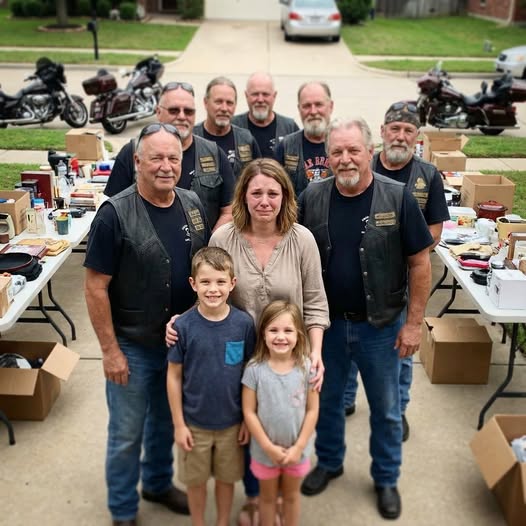
The day twenty bikers pulled up to my garage sale, I honestly thought life was just trying to embarrass me for fun. They bought everything—every plate, every toy, every keepsake from my family—and then told me to help carry it all back inside. I was sure they were mocking me. I thought they were preying on a woman who’d already hit rock bottom.
But what they came to do wasn’t cruelty at all. It was rescue.
My name is Rebecca Lawson. Six months before that day, I thought my life was stable—eighteen years of marriage, two amazing kids, a quiet home, and a husband I believed loved me. Then I walked into my bedroom and found him with his twenty‑four‑year‑old secretary. No apology. No shame. No denial. Just:
“I want a divorce. I was waiting for you to find out.”
Three weeks later, I discovered he had drained our bank accounts, maxed out credit cards under my name, and taken out a second mortgage I didn’t even know existed. He disappeared with his girlfriend, leaving behind two children, a pile of debt, and a house already months behind on payments.
I sold my car. Then my wedding ring. Still not enough.
Foreclosure letters piled up. The electricity was days from being cut off. Even school lunches became something I had to budget for. So I dragged everything we owned into the driveway and put price tags on the pieces of our life.
My daughter’s American Girl dolls.
My son’s baseball cards—his grandfather’s last gift.
My grandmother’s china.
My mother’s pearls.
Every sale felt like losing a memory I couldn’t get back.
That morning, my daughter Emma came outside in pajamas and saw her grandmother’s dollhouse on a table.
“Mom… why is it out here?”
“We need the money, sweetheart.”
“It was Grandma’s…”
“I know,” I whispered. “But we need somewhere to live.”
She didn’t cry. She just nodded—too grown for nine years old. Tyler didn’t say a word. He just carried boxes with an expression I didn’t recognize anymore.
By noon, I’d made only $127. People haggled over everything, offering insulting amounts. Pride was all I had left, and I clung to it even as we sank.
Then I heard the rumble.
Motorcycles—twenty of them—rolling down my street like thunder. The neighbors hid behind curtains. I told Emma to stay close. Told Tyler to go inside.
The biggest man stepped off his bike first—gray beard, leather vest, arms like stone. But his eyes were kind.
“Morning, ma’am. Having a sale?”
I nodded.
He surveyed the tables—the heirlooms, the toys, the memories. Something softened in his face. He turned to the others.
“Go on.”
They spread silently through the driveway.
One biker knelt by Emma’s dollhouse.
“This yours?”
She nodded.
“Someone special give it to you?”
“My grandma. Before she died.”
The man stood and whispered to the leader. They kept glancing over, as if they were seeing something in our family they recognized.
The leader returned to me. “Ma’am, we’d like to buy everything you’re selling.”
“All of it?” I asked.
“All of it.”
I calculated quickly. “Three thousand dollars.”
Without blinking, he counted out thirty hundred‑dollar bills and placed them in my trembling hands.
Then he said, “Now help us carry everything inside.”
“Inside? But you bought it.”
He shook his head gently. “My name’s Thomas. My son James is the one who spoke to your daughter. These men… they’re my brothers.”
I still didn’t understand.
“Rebecca,” he said quietly, “every man here has lost something—homes, families, pieces of their past they should never have had to give up.”
His voice cracked.
“I once sold my daughter’s crib for rent money. She died two years later. I’d give anything to have that crib back.”
My heart shattered.
He nodded toward James. “His mother left when he was four. I sold his baby pictures at a garage sale. His first steps. His first birthday. I didn’t have a choice.”
He looked back at me.
“We didn’t come to take your memories. We came to buy you hope. Time. A little bit of breathing room.”
My knees gave out. I dropped to the driveway, sobbing. Emma threw her arms around me. Thomas crouched beside her.
“They’re good tears, sweetheart,” he said softly. “Good things make grown-ups cry too.”
The bikers began carrying everything back inside—Emma’s dollhouse, Tyler’s cards, the pearls, the china—restoring our life piece by piece.
Tyler wandered out, confused at first, then slowly hopeful as James handed him the baseball cards.
“Your grandpa gave you these?” James asked.
Tyler nodded.
“Then don’t ever sell them. Ever.”
When everything was back in place, Thomas finally asked, “How much do you truly need to get back on your feet?”
I hesitated.
“Tell the truth,” he insisted.
“Fifteen thousand,” I whispered. “Maybe more.”
He called his wife, Marie, who ran a nonprofit for single mothers. She arrived with a clipboard, warm and steady, already forming a plan.
By the time they left, the mortgage was caught up. Utilities paid. Minimum payments covered. I was enrolled in job training. Childcare arranged. Not loans—help.
Before leaving, Thomas told me, “When you’re stable again, find someone drowning. Throw them the rope someone once threw us. That’s the only payment we want.”
Eight months later, I saw a young mother counting change for diapers. Exhausted. Panicked. Alone. I paid for her diapers. Talked to her. Called Marie.
Her name was Amanda. She made the same promise.
That’s how stories survive.
That’s how twenty bikers changed my life without taking a single thing that mattered.